
Leadership Between Worlds: Why Saudi Arabia’s Transformation Requires More Than Imported Leadership Models
Updated: May 19

Saudi Arabia is often described through the language of transformation: diversification, giga-projects, investment, technology, and Vision 2030. Yet beneath the visible story of infrastructure and economics sits another transformation that may matter even more: a shift in how leadership itself is understood.
Many organisations entering the Kingdom arrive with established assumptions about what effective leadership looks like. Speak up. Challenge authority. Move fast. Encourage open disagreement. Reward visible confidence. These ideas often work well in the environments in which they evolved. The problem is that they are frequently treated as universal truths rather than culturally shaped assumptions.
My own experience working in Saudi Arabia highlighted this immediately. Meetings discussing governance frameworks and delivery milestones would pause naturally for prayer and then continue seamlessly fifteen minutes later. Colleagues moved effortlessly between global corporate language and deeply rooted social traditions around honour, responsibility, faith, and family. It was not a clash between old and new worlds. It was a layering of them.
What struck me was that apparent differences often concealed a deeper misunderstanding. Behaviours that Western organisations interpreted as resistance, caution, or reluctance to challenge were frequently something else entirely.
They reflected different schemas.
Schemas are deeply learned patterns that shape how we interpret situations and decide how to act. They are not personality traits, nor indicators of competence. Rather, they are cognitive shortcuts — beliefs, emotional signals, and behavioural tendencies that become particularly influential under pressure.
We all have them.
In leadership development, we often focus on visible behaviours: communication style, decision-making, influencing skills. But behaviours are the surface expression. Schemas sit underneath. Our Assessments reveal these:
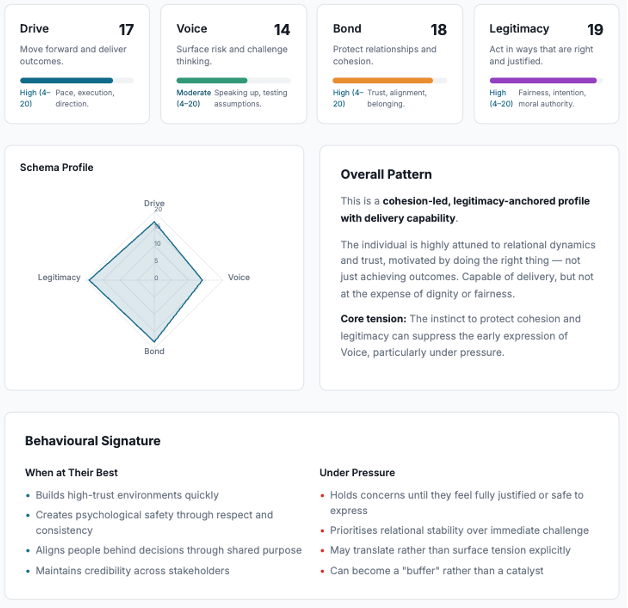
The challenge in Saudi Arabia is that organisations are increasingly asking people to operate across multiple schema systems simultaneously.
Many Western corporate models assume what might be called an instrumental leadership schema: "If the process works and the result is achieved, the behaviour was effective."
By contrast, Islamic and Arab traditions often carry a different underlying logic:
"If the behaviour is morally right and appropriately intended, the outcome gains legitimacy."
This distinction matters.
A leader may deliver impressive performance metrics, yet if they undermine trust, dignity, fairness, or intention along the way, authority can quietly erode.
This helps explain why some imported leadership practices misfire.
Take challenge and dissent.
Many Western organisations assume psychological safety means open disagreement in meetings. Speaking up is viewed as evidence of engagement. Yet in higher-cohesion cultures, public challenge can sometimes carry a different meaning. Rather than demonstrating commitment, it may be experienced as exposing others or threatening relational harmony.
Silence, therefore, should not always be interpreted as disengagement. Sometimes silence is protecting something.
This was recognised centuries ago by the fourteenth-century thinker Ibn Khaldun, whose concept of ʿasabiyyah described the social cohesion that binds groups together. Through a behavioural lens, we might think of this as a form of collective macro-schema — a shared understanding of loyalty, legitimacy, and belonging.
Strong cohesion creates extraordinary coordination and commitment. Yet cohesion can also become restrictive if challenge is interpreted as disloyalty.
The leadership question then becomes: how do we create challenge without creating rupture? This is where schema-based leadership development becomes particularly relevant for organisations operating in KSA. Once we identify the cultural schema mismatches, we can work on them:

Traditional leadership development often focuses on transferring behaviours: teach leaders to challenge more, become more visible, encourage greater openness.
A schema approach asks different questions:
• What assumptions sit beneath these behaviours?
• What emotional signals do they create?
• What meaning do people attach to them?
• How might the same intention be expressed differently?
For example, rather than framing challenge as criticism, leaders might frame it as protection: "Raising risks early helps us protect the team, the project, and the Kingdom."
The behaviour itself may remain similar. The meaning changes entirely.
In our own schema framework, leaders often operate through patterns such as Commander, Architect, Collaborator, and Servant schemas. Under pressure, these become more pronounced. A highly developed Commander schema may bring speed and decisiveness, but overused in high-cohesion environments it can unintentionally suppress voice. An Architect schema may create excellent systems and governance, but can overlook cultural meaning. Servant and Collaborator patterns often help leaders preserve legitimacy and trust.
The aim is not to replace one schema with another; it is to develop flexibility.
For leadership development in Saudi Arabia, this matters enormously.
Vision 2030 is not simply importing Western leadership models into a new setting. It represents something more ambitious: integrating performance-focused leadership with deeply rooted systems of cohesion, stewardship, and moral legitimacy.
The leaders who succeed are rarely those who abandon local foundations or copy external practices wholesale. They become translators. They understand that effective leadership is not about exporting behaviours. It is about translating intentions.
That may ultimately be the most important leadership capability of all.


Comments